Recognizing the Symptom
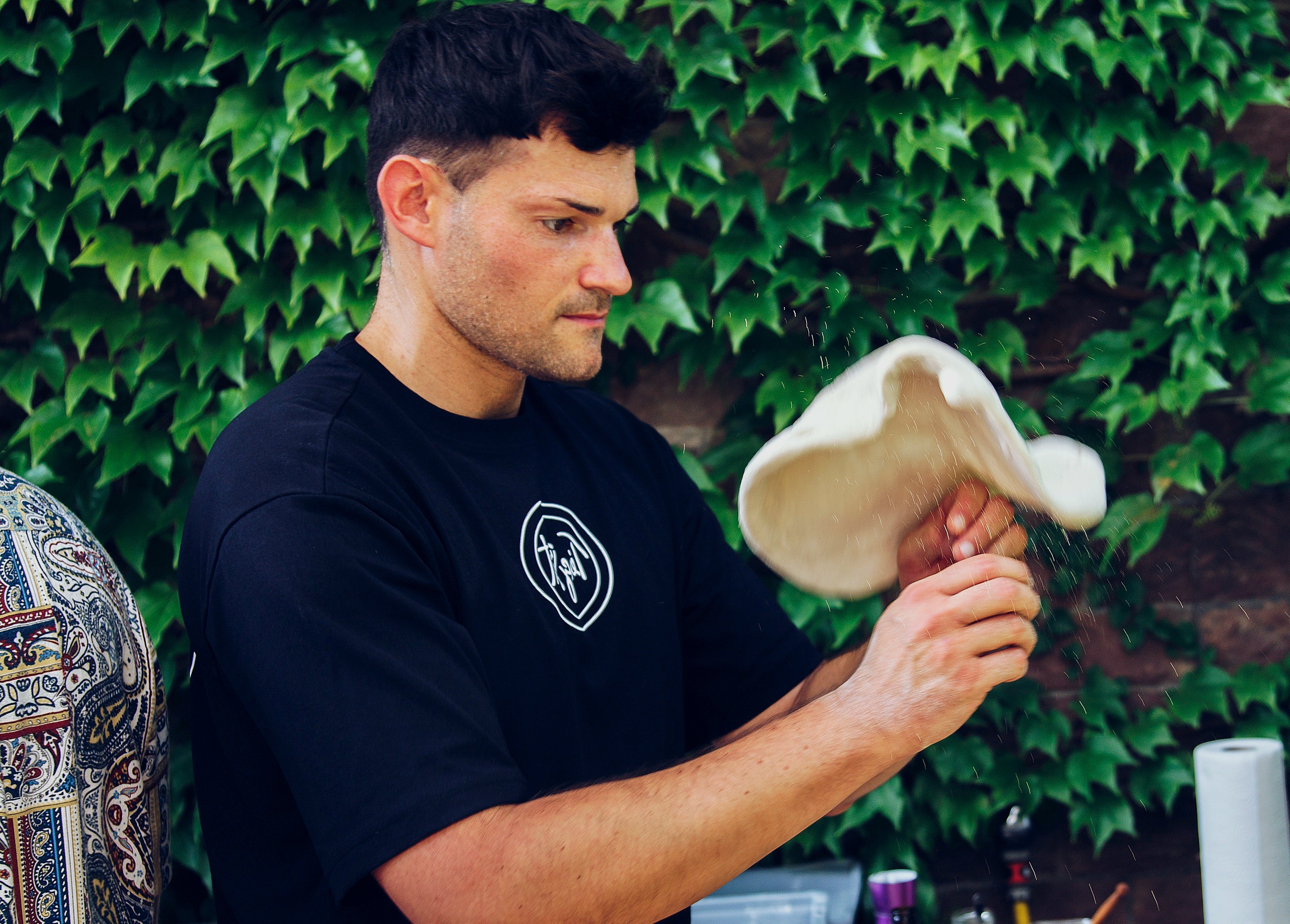
The dough or dough ball feels taut, compact, and tough, can only be stretched with effort, and contracts again after stretching. It feels rather dry and unyielding.
The baked pizza has a hard, dry, almost cracker-like base that snaps instead of bending. This only shows up when eating.
Is the base more firm than hard right out of the oven, and does it only turn tough and chewy as it cools? Then heat or drying probably isn’t the cause – it’s more likely too little fermentation gas before baking combined with hydration that’s too low, which is a separate issue. See our diagnosis on Pizza Crust Chewy or Tough After Baking.
Causes
Part A – Dough too stiff (before baking)
Every flour has – depending on its strength (W-value) – a water percentage at which the dough handles well. If the hydration is significantly below that, the dough becomes stiff and hard to stretch. The stronger the flour, the more water it needs; a strong flour with too little water therefore produces a particularly stiff dough.
Cold dough is more elastic and tighter. Straight from the refrigerator it is hard to open and contracts strongly.
A too-short ball proofing is not a cause of stiff dough – but it amplifies its symptoms. Conversely, a stiff dough needs a sufficiently long ball proofing to become manageable at all: during ball proofing the dough ball releases tension and becomes more extensible. If it is too short, a lot of residual tension remains, and the already stiff dough contracts even more when shaping.
Part B – Base too hard (after baking)
The lower the baking temperature, the longer the baking time and the more water evaporates. Too long a bake with too little heat dries out the base – it becomes hard and cracker-like instead of crisp yet tender. Often it is bottom heat in particular that is missing.
Found your cause but still unsure what to do?
Solution: Step by Step
Dough too stiff – immediately, with the finished dough
Let them acclimatize for 2–3 hours until they reach room temperature. Ideally place them in a spot as warm as possible, but not above about 30 °C – warm dough is softer and more supple than cold dough and stretches more easily.
If the dough springs back, let it rest briefly and start again instead of pulling with force.
Dough too stiff – structurally, for next time
Don’t change everything at once – work in priority order:
Slightly increase the water percentage, matched to the strength of your flour. Increase step by step (e.g. a few percentage points first) and watch the handling – a softer dough is more demanding.
A stiff dough needs more time to relax. A long ball proofing releases the residual tension and makes it more extensible and easier to handle. This does not fix the stiffness itself, but it removes the most difficult symptoms when shaping.
If the flour is very strong and you don’t want to hydrate higher, a somewhat weaker flour can make the dough naturally more supple.
Base too hard – immediately, next bake
So the base does not dry out.
Use a pizza stone or pizza steel preheated well and long enough.
Structurally: Work with more heat and a shorter baking time permanently. If your oven cannot reach enough temperature, the baking setup (stone/steel, preheating, top heat) is the decisive lever. If more heat is not possible, a higher hydration can keep the base moister and counteract drying out.
Prevention
- Choose the hydration to match the strength of your flour from the start – don’t set it too low (more on this in our deep dive on hydration).
- Give a stiff dough a sufficiently long ball proofing so the dough ball relaxes, becomes extensible, and is easy to work with.
- Let the balls acclimatize before shaping – don’t work them ice-cold from the refrigerator.
- Bake hot and short instead of long and lukewarm, with well-preheated bottom heat (stone/steel), so the base turns crisp instead of hard.
So that flour, hydration, and timing match, the can suggest a suitable hydration and dough schedule from your inputs – your flour is classified via its protein content.