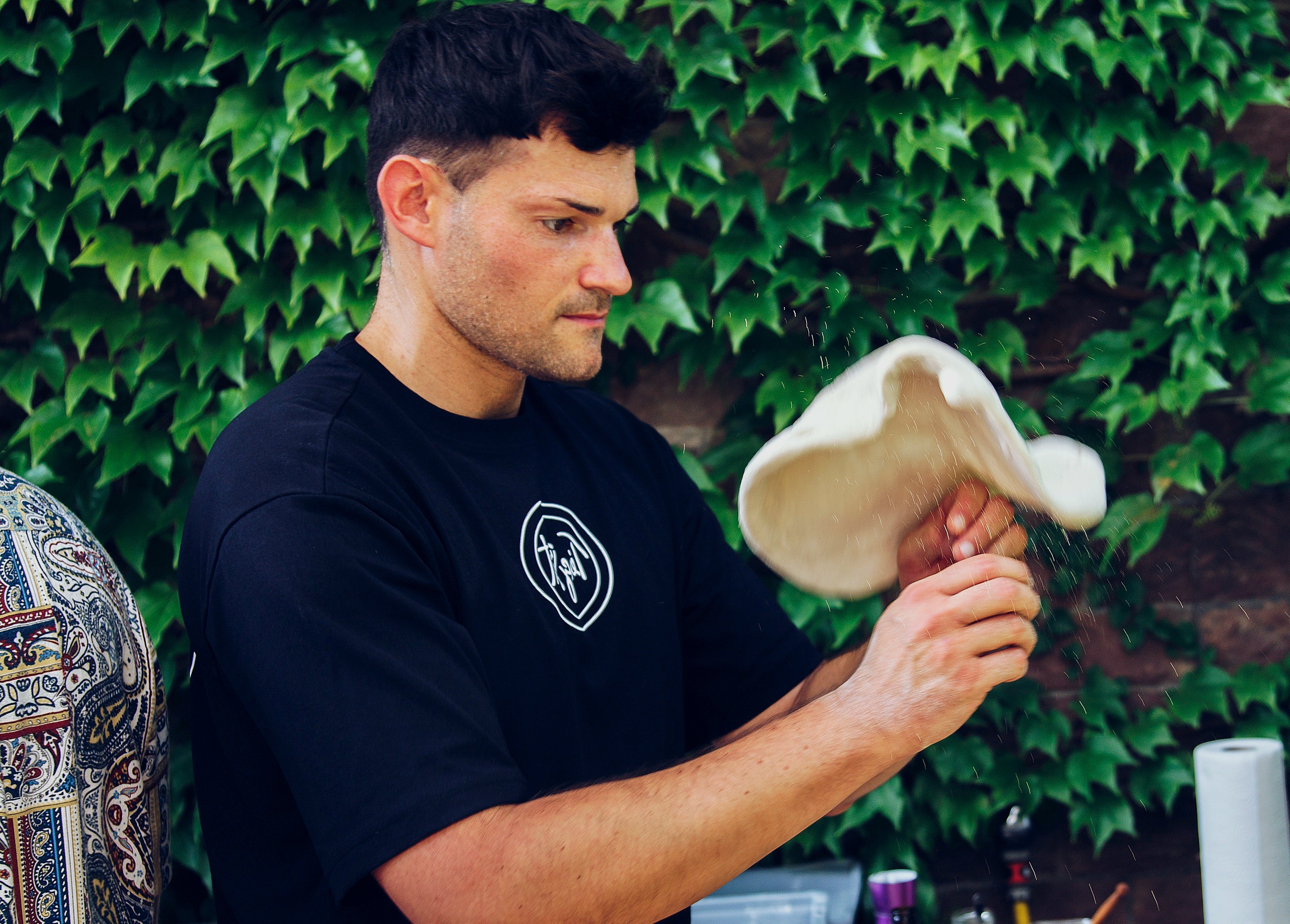
Recognizing the Symptom
The tearing occurs when stretching – not during baking. Typical signs:
- The pizza base tears when stretching, usually in the center.
- The center becomes extremely thin, holes form.
- The dough skin tears immediately during the windowpane test and cannot be stretched thin and translucent – an indicator of an underdeveloped gluten network.
For distinction: if the dough mainly springs back strongly without tearing, it is too elastic (“springs back”) – a separate issue with a different cause.
If the dough tears already while kneading, the cause is related but not identical – see the FAQ below for that case.
Causes
If the seam on the underside of the ball is not fully sealed during balling, a mechanical weak point remains. When stretching, this spot thins out and tears – often as a hole or thin area in the center.
With a lot of bulk fermentation, much gas has already formed in the total dough. When dividing and balling, these large gas bubbles are redistributed and make it hard to seal the seam cleanly. The seam can then barely be fully pressed shut – the weak point remains.
If the dough was not kneaded sufficiently (windowpane test tears immediately), the gluten network is incomplete. Such a dough has an uneven surface and tears easily.
If the dough is enzymatically over-ripe, the gluten is broken down, the dough loses structure and gas-holding ability, and becomes very soft and sticky. It then also tears easily or develops holes. When it comes to tearing while stretching, however, this is less often the cause than seam closure and bulk-to-ball ratio.
Found your cause but still unsure what to do?
Solution: Step by Step
Immediately, before stretching
Are there gaps or openings visible? If so, gently press together with fingers – not too hard so gas is not lost, but securely closed.
Press the gas evenly from center to edge into the rim; do not pull to maximum size.
This is a rescue for the current pizza, not a fix for the root cause.
Structurally, for next time
Don’t change everything at once – work in priority order:
Less bulk fermentation, more ball proofing at the same total time. This means less gas in the total dough, smaller and more even bubbles, and the seam can be fully sealed much more easily during balling.
Fold dough from outside to center, press the seam firmly together, and roll the ball seam-side down with light pressure on the work surface to seal the seam. Works best when Prio 1 is correct.
Only if the dough is still hard to seal despite Prio 1 and 2. A slightly softer dough is easier to seal cleanly – see our deep dive on hydration for how to find the right value.
For under-kneaded dough: next time knead at least 15 minutes or do several rounds of stretch and fold with rest periods, then verify with the windowpane test.
Prevention
- Always fully close the seam when balling – this is the single most important measure.
- Balance bulk and ball proofing so the gluten network relaxes but stays stable. The optimal ratio is almost never at the extremes.
- Knead the dough fully and verify with the windowpane test (thin, translucent skin that does not tear immediately).
- Avoid over-proofing: aim for approximately a doubling over the total proofing time (see How to recognize and rescue over-proofed dough).
- Let balls acclimatize before stretching – take them out of the refrigerator in time. A warmed, relaxed dough ball opens more evenly and with less tearing.
So that yeast quantity, time, and hydration match from the start and the dough doesn’t over-proof, the pizzAI dough calculator can suggest appropriate values from your inputs – including the ideal split between bulk and ball proofing for your recipe.