Recognizing the Symptom
Straight out of the oven, the pizza is more firm to hard – not necessarily “tough” yet. As it cools, the texture increasingly changes: the crust and rim turn leathery, chewy, and noticeably harder to chew. Important for distinguishing this: the crumb doesn’t feel moist, sticky, or raw (that would be over-proofing, see above).
By the way: You’ve probably experienced exactly this pattern with delivery pizza. It often comes out of the oven already relatively firm/dry, then spends a longer stretch closed up in the box. The moisture that escapes the pizza as it cools can’t get out and gets partly reabsorbed as it cools slowly – which intensifies the tough, leathery, chewy bite even further.
Causes
The following causes don’t act independently of each other – they drive and reinforce one another. Only their combination reliably produces the tough, leathery, chewy bite.
Too Little Fermentation Gas in the Dough Ball Before Baking
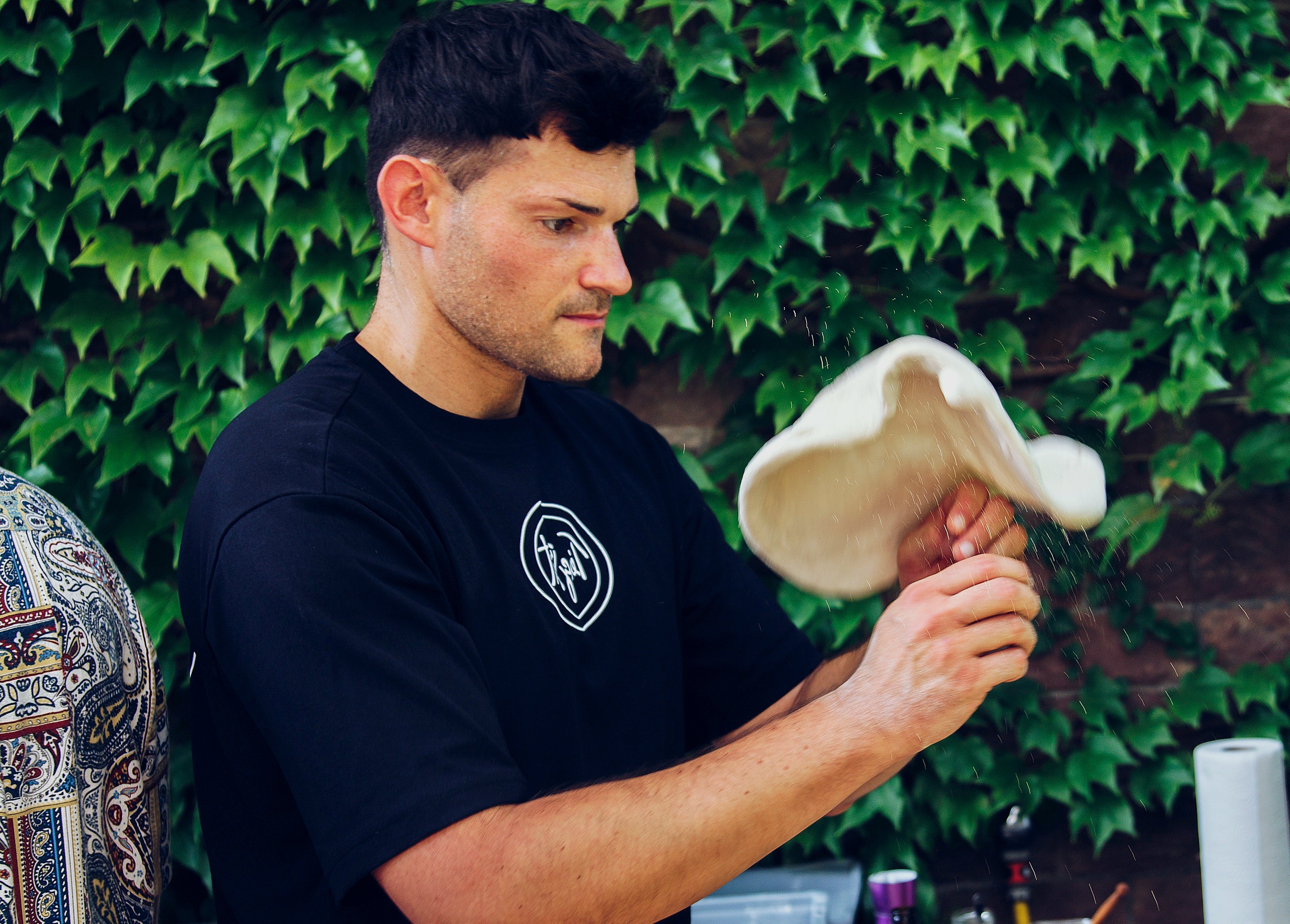
This can have two causes: under-proofing (too little proofing time or too little yeast for the chosen temperature, clearly short of the targeted 1× doubling) or shaping that’s too rough and forceful, which pushes most of the trapped fermentation gas out of the dough. Either way, the structure stays dense instead of light and open.
Hydration Too Low for the Flour and Bake, or Baked Too Long at Too Little Heat
Both the flour (depending on W-value or protein content) and the baking temperature/duration each have their own matching hydration range. If the actual hydration doesn’t match both – and it’s too low rather than too high – the pizza comes out of the oven hard at first and turns tough as it cools. Typical example: a strong flour, baked in a home oven (lower temperature, longer bake time) combined with low hydration of, say, 55%. The works out the right match between flour strength, baking temperature, and hydration for you, so you don’t risk this mismatch in the first place.
The Actual Cooling Effect
A dense, low-moisture structure (from the two points above) is the precondition – but the bite only turns tough, leathery, and chewy once the pizza cools and isn’t eaten right away. The longer it sits, especially in a closed, humid environment (see the delivery pizza example above), the more pronounced the effect.
Missing Fat in the Dough
Fat attaches to the protein structures, slows gluten network formation, and lowers the maximum gas-holding capacity – the result is a softer, more tender crumb with more extensibility and less elasticity. Fat in the dough actively works against a tough, leathery, chewy bite.
Caution with the fix: More hydration only helps up to a point. If hydration is pushed beyond the range that matches the flour, the problem flips in the other direction – the dough becomes too soft and loses structure, rather than staying tough after baking.
Found your cause but still unsure what to do?
Immediate Fix (For the Current Pizza)
There’s nothing you can do about the hydration itself once the dough is already made – that’s strictly a point for the next batch (see Prevention below). For the current pizza, here’s what’s left:
If the dough ball hasn’t been baked yet and volume increase looks clearly low: if there’s still time, let it proof a bit longer before baking.
When shaping, work carefully rather than forcefully, so as much fermentation gas as possible is preserved and the rim can puff up properly.
If your oven can handle it: bake as hot and briefly as possible instead of long at a low temperature – that limits moisture loss and, with it, how hard the pizza starts out.
If the pizza is already baked: eat it immediately while hot, don’t let it sit in a closed container.
If it’s already cooled and turned tough: a brief, very hot reheat can improve the texture somewhat – not completely, but noticeably.
Prevention (Structural – for Your Next Pizza Session)
- Choose hydration to match both flour strength and baking temperature – easiest via the , which works out the right match between flour strength, baking temperature, and hydration for you.
- Make sure there’s enough volume increase before baking (about 1× doubling), and handle the dough gently rather than forcefully when shaping so the fermentation gas is preserved.
- At a lower baking temperature, don’t bake too long; go hotter and shorter if you can.
- Work 2–5% fat (e.g. olive oil, relative to the flour weight) into the dough – it actively counters toughness.
- Eat the pizza as soon as possible after baking; don’t store it long in a closed, humid container.
Distinction From “Pizza Dough Too Hard/Stiff”
This page covers a crust and crumb that turn tough, leathery, and chewy once the pizza cools – straight out of the oven it’s more just firm to hard, not raw or moist. Our deep dive on dough that’s too stiff covers two different cases: raw dough that’s hard to stretch and springs back before baking (hydration, ball proofing, flour strength), and a finished crust that stays permanently hard and cracker-like (no texture change even after cooling). A moist, sticky, raw-looking crumb despite a browned crust is neither of these – that’s over-proofing, see our deep dive on over-proofing.